
WHITE PAPER
The $15-20M Problem Delaying Your Next Data Center:
How the Commissioning Skills Gap Threatens Hyperscale Timelines
Discover why nearly 300,000 qualified commissioning professionals will be needed, and how the transition from Industry 4.0 to 5.0 is widening the gap between what facilities require and what today's workforce can deliver.
Every month of commissioning delay costs hyperscale facilities over $15 million in lost revenue and financing charges. Yet the shortage of skilled commissioning professionals—experts who validate that power, cooling, and control systems perform exactly as designed—is intensifying as data centers grow more complex. This white paper reveals the scope of the crisis and provides a clear roadmap for owners, EPCs, and commissioning authorities to protect project timelines.
What You'll Learn: Critical Insights for Data Center Stakeholders
The Financial Impact
- $15-20M+ potential monthly exposure for 50MW+ hyperscale delays
- $1-1.5M monthly risk for 5MW edge/enterprise facilities
- 1-3% of CAPEX in hidden warranty costs within first two years due to poor commissioning quality
The Workforce Reality
- Nearly 300,000 qualified professionals needed globally by 2025
- 19% of UK / 16% of US data center workforce nearing retirement
- Three critical gaps: Technical knowledge, digital skills, and leadership pipeline
The Industry 5.0 Shift
- AR/VR-guided commissioning procedures
- Human-robot collaborative testing workflows
- Integrated sustainability metrics in commissioning protocols
- Digital twin simulation and predictive analytics
Why This White Paper Matters to Your Organization
For Owners & Operators
Protect Your Timeline and Budget
Understand how commissioning bottlenecks cascade into multi-million-dollar delays. Learn contractual strategies to ensure your commissioning authority demonstrates training pipelines, digital capabilities, and certified expertise (CxA, CDCCP) before contract award. Discover why modularization and standardized Owner Project Requirements (OPRs) across campuses streamline commissioning workflows and reduce dependency on scarce talent.
For EPCs & Construction Managers
De-Risk Project Delivery
Learn how to mitigate commissioning bottlenecks by awarding multiple subcontracts to qualified commissioning authorities, promoting workforce certifications, and investing in AR/VR training platforms. Access strategies for hybrid skill development that prepare teams for next-generation infrastructure demands including liquid cooling, high-density computing, and integrated DCIM environments.
For Commissioning Authorities
Future-Proof Your Competitive Position
Discover workforce development frameworks that attract and retain commissioning talent in a competitive market. Understand how investments in digital twin platforms, connected worker technologies, and Industry 5.0-aligned training programs differentiate your firm while addressing the technical competency gaps that threaten project success.
Inside the White Paper: A Comprehensive Analysis
Executive Summary & Introduction
Global data center investment through 2030 will reach $1.8 trillion, yet the commissioning workforce faces critical shortages. This section frames both the quantitative challenge (insufficient professionals) and qualitative challenge (insufficient skills for emerging technologies) that threaten project timelines from Dubai to Northern Virginia.
The Commissioning Skills Gap: Three Critical Deficits
Technical knowledge gaps in critical power, HVAC, and automation systems combine with digital skills deficits (unfamiliarity with digital twins, BIM integration, AI-enabled workflows) and leadership gaps as experienced commissioning managers retire. The Uptime Institute estimates nearly 300,000 qualified staff needed globally by 2025, with commissioning specialists among the hardest roles to fill.
Industry 4.0's Impact on Commissioning
Digitalization, IoT, and AI have transformed commissioning from sequential, manual processes into integrated, data-driven workflows. BIM and IoT-enabled systems enable parallel testing across electrical, mechanical, and control systems during L3-L5 phases. Real-time sensor data and digital twins allow predictive adjustments during commissioning rather than post-testing rework—but require new competencies most professionals lack.
The Industry 5.0 Evolution
Human-machine collaboration, augmented reality guidance for less-experienced technicians, collaborative robotics for repetitive testing, and integrated sustainability metrics represent the next frontier. Commissioning professionals must evolve into hybrid experts combining engineering fundamentals, digital tool proficiency, sustainability knowledge, and cross-functional leadership.
The True Cost of Delays: Facility-Specific Financial Exposure
Detailed cost modeling reveals monthly delay risks ranging from $2-3M for 5MW edge facilities to $15-20M+ for hyperscale deployments. Analysis covers lost revenue, financing costs, labor overruns, equipment rentals, and quality failure risks that compound over the first two years of operations.
Evidence-Based Strategies to Close the Gap
Stakeholder-specific recommendations for owners (contractual workforce development requirements, modularization), EPCs (multiple commissioning subcontracts, certification promotion), commissioning authorities (talent retention, digital platform investment), academia (Industry 5.0 curricula), and governments (workforce mobility, reskilling incentives).
DataQuestCX Solutions: Immediate Impact + Long-Term Pipeline Development
Our embedded training programs, custom script development, and operational readiness support provide immediate capacity while advisory integration, documentation standards, and cross-training protocols build institutional resilience against workforce shortages.
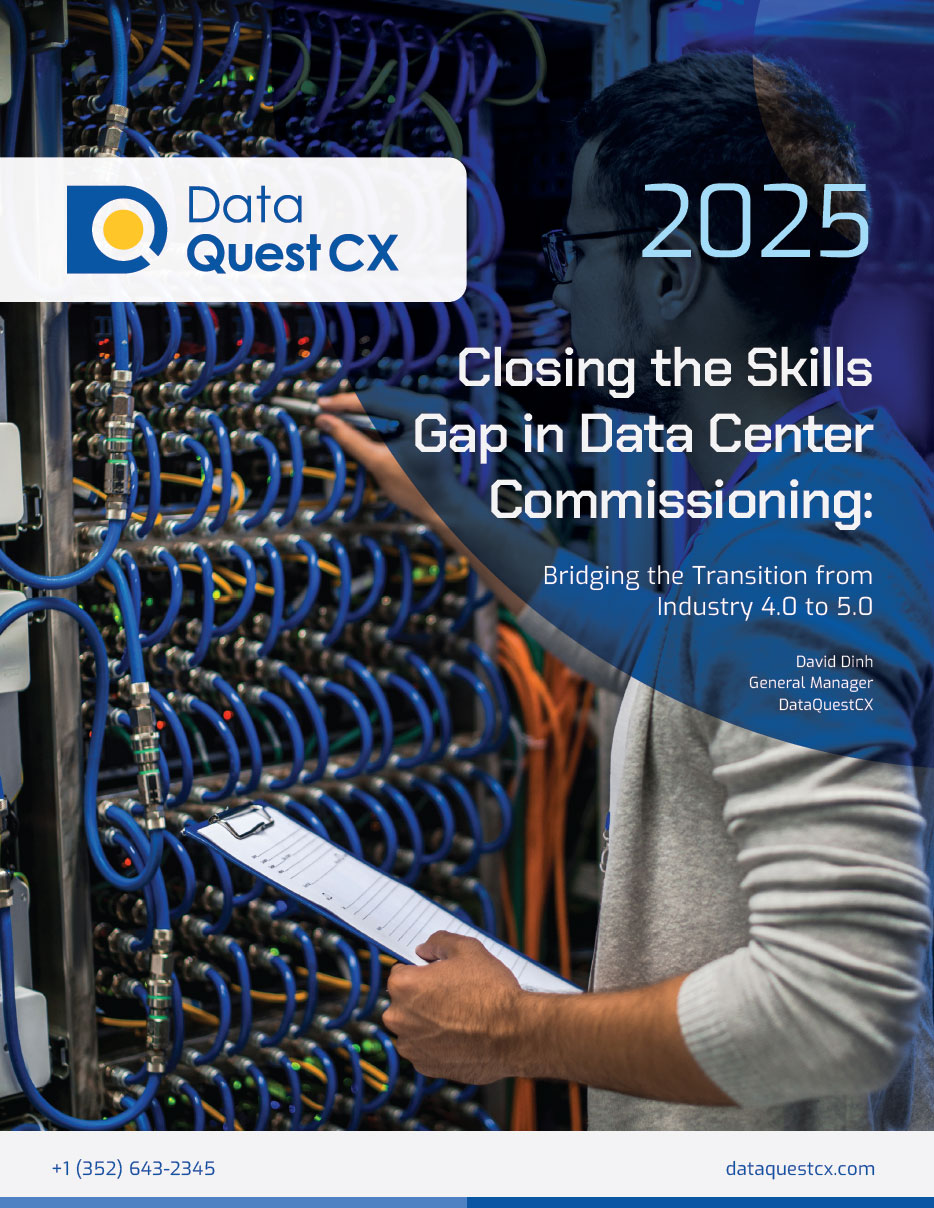
WHITE PAPER
Closing the Skills Gap in Data Center Commissioning
Get the full 14-page white paper including:
✓ Detailed cost exposure tables by facility size
✓ Stakeholder-specific action plans with timelines
✓ Industry 4.0 vs. 5.0 commissioning comparison matrix
✓ 13 peer-reviewed references and industry sources